
Summary:
- Impacted wisdom teeth are third molars that fail to erupt properly due to limited space or misalignment.
- Leading causes for impacted wisdom teeth are: insufficient jaw space, abnormal tooth angle, genetics, and dental crowding.
- The main types of an impacted wisdom tooth are: mesial, distal, vertical, and horizontal.
- Symptoms of an impacted wisdom tooth include: gum swelling, jaw pain, bad breath, and difficulty chewing.
- Untreated impacted wisdom teeth can lead to: infection, cyst formation, gum disease, or bone loss.
- Treatment options for an impacted wisdom tooth are: removal or regular monitoring with X-rays.
- Removal of an impacted wisdom tooth is a routine oral surgery performed under local anesthesia or sedation
- The recovery period of an impacted wisdom tooth is normally 7-14 days.
- The cost of having an impacted wisdom tooth removed in Turkey is typically 50-70% less than the prices of UK private clinics.
- An impacted wisdom tooth procedure in Turkey usually requires a short 3-5 day stay for consultation, surgery, and post-operative care.
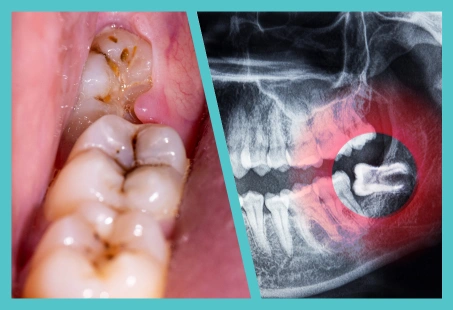
An impacted wisdom tooth is a third molar that doesn’t have enough space to fully emerge or develop properly in the mouth. Instead of growing upright like other teeth, it may remain trapped beneath the gum or bone, or grow at an angle toward neighboring teeth. Knowing why it occurs and how it’s treated can help you protect your oral health before problems start.
Why Do Wisdom Teeth Become Impacted?
Impaction typically occurs when there isn’t enough room in the jaw for the tooth to erupt naturally. Genetic factors, late jaw development, or the size and position of neighboring molars can all contribute. Because impacted teeth are difficult to clean, they are also more prone to decay and gum disease.
What Are the Types of Impacted Wisdom Teeth?
Impacted wisdom teeth are classified based on the angle and position of the tooth in the jaw. Dentists usually identify these patterns on X-rays before recommending treatment.
Mesial Impaction
- The tooth tilts forward toward the front of the mouth.
- Most common impaction type, often pressing against the second molar.
Distal Impaction
- The tooth angles backward toward the rear of the mouth.
- Less frequent, but may be more challenging to remove due to jaw anatomy.
Vertical Impaction
- The tooth is correctly oriented but fails to erupt fully through the gum.
- May remain asymptomatic or cause pain if gum tissue traps bacteria.
Horizontal Impaction
- The tooth grows completely sideways in the jawbone.
- Exerts pressure directly onto the root of the second molar.
- This is typically the most problematic form.
What Are the Common Symptoms of an Impacted Wisdom Tooth?
Some patients only discover they have an impacted wisdom tooth during a routine dental check-up, while others experience persistent discomfort and swelling that signals a problem requiring prompt attention.
Typical symptoms of an impacted wisdom tooth include:
- Pain or tenderness at the back of the mouth.
- Swelling or redness of the gums.
- Difficulty opening the mouth or chewing.
- Bad breath or an unpleasant taste due to trapped food and bacteria.
What Are the Complications Linked to an Impacted Wisdom Tooth?
If an impacted tooth is left untreated, it may cause various oral health complications, ranging from infections to bone damage:
- Infection (Pericoronitis): Inflammation of gum tissue surrounding a partially erupted wisdom tooth, sometimes with pus and swelling.
- Cyst Development: Fluid-filled sacs forming that can damage bone and nearby teeth
- Benign Tumors: Rare but possible growth related to chronic impaction.
- Damage to Adjacent Teeth: The root or enamel of the second molar can be compromised by constant pressure.
- Gum Disease and Tooth Decay: Hard-to-clean areas around the tooth are prone to bacteria buildup.
- Bone Loss: Chronic infection can cause deterioration of the jawbone.
What Causes Impacted Wisdom Teeth?
An impacted wisdom tooth occurs when the third molar cannot fully emerge into its correct position This can happen for several reasons:
Insufficient Jaw Space
- Many people have smaller jaws today, leaving little to no room behind the second molars.
- As a result, tooth may stay partially covered by gum tissue or fully trapped in the jawbone.
Abnormal Growth Angle
- The tooth may tilt forward (mesial), backward (distal), sideways (horizontal), or rotate in the bone.
- These misalignments can cause crowding, enamel wear, or damage to the second molar.
Genetics and Jaw Shape
- Inherited jaw size and tooth size affect whether wisdom teeth can erupt normally.
- A family history of impacted wisdom teeth increases the likelihood of developing the same issue.
Pre-Existing Dental Crowding
- Right spacing in the dental arch reduces room for new molars to come through.
- Even partially erupted wisdom teeth can shift surrounding teeth over time.
Removal or Monitoring: What to Do with an Impacted Wisdom Tooth?
Not every impacted wisdom tooth needs to be removed right away. Dentists evaluate each case with panoramic X-rays or CBCT scans. This helps assess its position, depth, relation to nerves and sinuses, and any effect on nearby teeth or bone.
When Wisdom Tooth Removal Is Recommended
Extraction is advised if the impacted tooth is:
- Causing ongoing pain or swelling.
- Infected (pericoronitis) or linked to cysts or bone damage.
- Damaging the second molar through decay, gum disease, or root resorption.
- Contributing to crowding or bite alignment issues.
When Monitoring Is Appropriate
In some cases, removal may not be necessary. Observation may be chosen if the tooth is:
- Symptom-free with healthy surrounding tissues.
- Stable in position and unlikely to cause harm.
- if the tooth is in a patient with higher surgical risks
Regular reviews every 6–12 months with updated X-rays ensure any changes are detected early for timely intervention.
What Is the Treatment Process for an Impacted Wisdom Tooth?
The removal of an impacted wisdom tooth is a routine oral surgery procedure performed by a dentist or oral and maxillofacial surgeon.
Step 1; Local Anesthesia or Sedation
- The area is numbed with local anesthesia.
- For anxious patients or complex extractions, sedation or general anesthesia may be offered for comfort.
Step 2; Incision in the Gum
- A small incision is made in the gum tissue to expose the impacted wisdom tooth and underlying bone.
- If the tooth is partially erupted, minimal gum access may be needed
Step 3; Bone Removal (If Necessary)
- If part of the jawbone is blocking the tooth, a small portion is carefully removed.
- The amount of bone removed is kept to the minimum required for safe extraction.
Step 4; Sectioning the Tooth
- In cases where the tooth is large, deeply embedded, or awkwardly positioned, it is divided into smaller sections.
- This technique makes removal easier and reduces stress on surrounding bone and tissues.
Step 5; Cleaning the Surgical Site
- Once the tooth is removed, the area is thoroughly cleaned to eliminate any debris, bone fragments, or infected tissue.
Step 6; Stitches (If Required)
- Stitches may be placed to close the incision and support healing.
- Dissolvable stitches are commonly used, but sometimes non-dissolvable ones are chosen depending on the case.
What Is the Recovery Timeline and Aftercare for an Impacted Wisdom Tooth?
Most patients recover from impacted wisdom tooth surgery within 7–14 days, though healing time can vary depending on the tooth’s position, the surgical complexity, and individual health.
Recovery Timeline
- First 24 Hours: Rest and avoid exercise, expect mild bleeding, swelling, and discomfort are normal.
- 2–3 Days: Swelling peaks, then decreases. Soft foods are recommended.
- 1 Week: Stitches (if not dissolvable) may be removed; most daily activities can resume.
- 2 Weeks: Gum tissue is typically healed; full jawbone healing may take several months.
What Are the Aftercare Instructions Following Wisdom Tooth Extraction
- Pain & Swelling: Use prescribed or OTC pain relief and apply cold compresses in the first 24 hours.
- Oral Hygiene: Avoid brushing directly over the surgical site for the first day; rinse gently with warm salt water after meals starting 24 hours post-surgery.
- Diet: Stick to soft foods like yogurt, soups, and mashed vegetables; avoid hard, chewy, or spicy foods.
- Avoid Dry Socket: Avoid smoking, alcohol, straws, or forceful spitting for at least 5–7 days.
- Follow-Up Visits: Attend scheduled check-ups to monitor healing and remove stitches if necessary.
- Watch for Infection: Contact your dentist immediately if pain worsens, swelling increases, or you notice fever, pus, or a bad taste in your mouth.
Why Choose Turkey for Impacted Wisdom Tooth Treatment?
Choosing Turkey for impacted wisdom tooth removal combines expert surgical care, lower treatment costs, and short, convenient treatment timelines. Many clinics employ oral and maxillofacial surgeons with international training and use the same advanced diagnostic and surgical equipment found in UK private practices, but at a fraction of the cost.
Average Cost per Impacted Wisdom Tooth Extraction
| Location | Turkey | UK Private Clinics |
|---|---|---|
| Standard Extraction | £35–£150 | £225–£500 |
| Complicated Surgical Extraction | £130–£370 | £500–£1,550 (high-end clinics) |
- In Turkey, even complex surgical extractions typically cost 50–70% less than UK private clinic prices.
- Lower prices do not mean lower quality, many Turkish dental centers meet or exceed European clinical standards, with advanced sterilization protocols and modern facilities.
- The price often includes the consultation, panoramic X-rays or CBCT scan, surgery, and follow-up checks.
How Long Should You Stay in Turkey for Wisdom Tooth Removal?
A typical wisdom tooth removal in Turkey involves several key steps spread across a few days, including:
- Day 1: Initial consultation, oral exam, and panoramic X-ray or CBC .
- Day 2: Surgical removal of the impacted wisdom tooth under local anesthesia or sedation.
- Day 3–4: Post-op review, aftercare guidance, and remove non-dissolvable stitches if placed.
- Recommended Stay: 3–5 days in total, allowing enough time for both the procedure and short-term recovery before traveling home.
What Are the Additional Benefits of Wisdom Tooth Removal in Turkey?
Here are some of the key reasons why many international patients prefer Turkey for wisdom tooth removal:
- Short waiting times compared to the NHS or busy UK private practices.
- Options for sedation dentistry to improve patient comfort.
- Opportunity to combine treatment with a short break in one of Turkey’s major cities or coastal destinations.
An impacted wisdom tooth can quickly shift from symptom-free to severe, causing pain, gum swelling, and even damaging nearby teeth if left unchecked. Seeking early treatment in Turkey ensures simpler surgery, faster recovery, and peace of mind knowing your smile is protected. Whether you need expert removal or careful monitoring, the right care can make all the difference.
Don’t wait for the pain to start, book your free consultation in Turkey today and get expert advice on your impacted wisdom tooth.
